
Walker vs Rollator – How to Choose the Right Mobility Aid for You
Choosing between a walker and a rollator isn’t always obvious. Both help with balance and mobility, but they work differently and suit different needs. Getting the right one can make a real difference to your safety, confidence, and how much you can do on your own each day.
What Is a Walker?
A walker is a mobility aid with a lightweight metal frame and four legs. The traditional walker has no wheels — you lift it, move it forward, then step into it. Most models fold flat for easy storage or transport. A standard walker is also one of the most prescribed mobility devices after surgery or injury because it offers firm, stable support with no rolling. If you need maximum stability and can bear your own weight partially, a walker is typically the go-to starting point that therapists and doctors recommend.
What Is a Rollator?
A rollator is a wheeled walker with three or four wheels, hand brakes, and usually a built-in seat. Unlike a traditional walker, a rollator is designed to roll continuously as you walk — you push it forward rather than lift it. Most rollators also include a storage basket underneath the seat and padded seat for resting. A rollator is best for people who can walk fairly well but need help with balance or endurance. It’s especially popular as an elderly walking aid for longer distances both indoors and outdoors.
Key Differences Between Walkers and Rollators
Understanding the key differences between walkers and rollators helps you figure out which one matches your actual daily life.
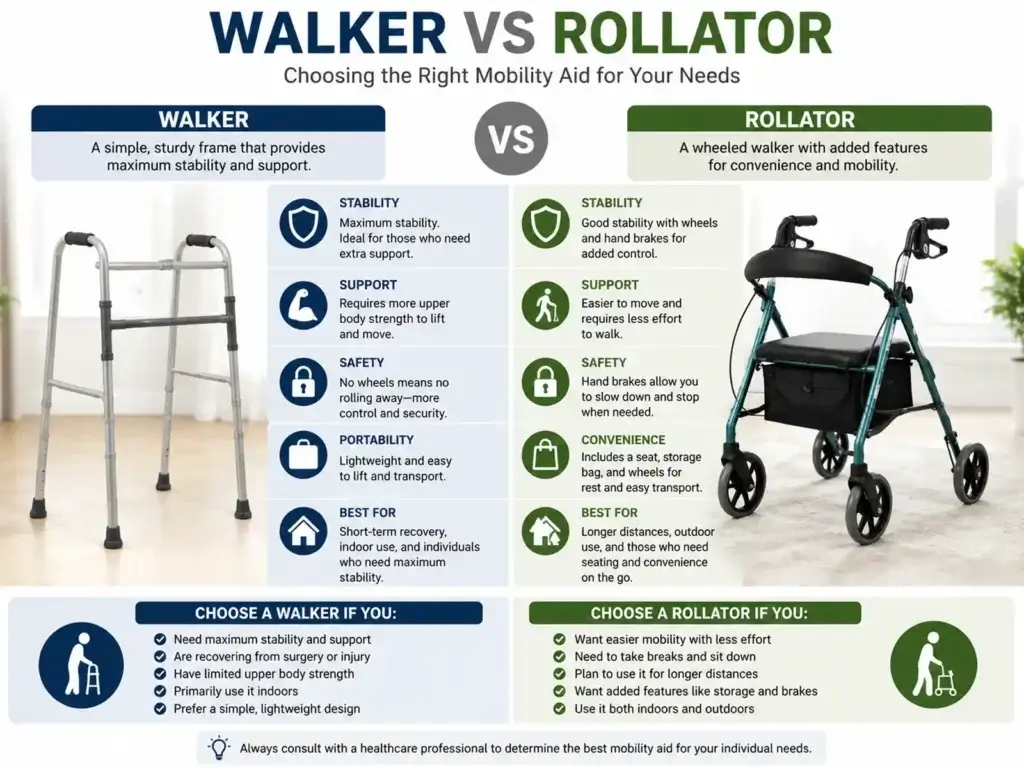
The biggest difference between a walker and a rollator is how they move. A walker typically requires you to lift it with each step, while a rollator rolls along with you. That means a walker gives more direct weight support — you can press down on it — whereas a rollator is meant to guide and steady, not bear your body weight.
Walkers have no wheels or just two front wheels. Rollators have three or four wheels, plus hand brakes you squeeze to stop. Rollators are heavier and bulkier than most walkers, but they offer the bonus of a rest seat and storage basket. Walkers are lighter than a rollator in most cases and easier to maneuver in tight spaces. The right choice between a walker or a rollator depends on how much support you need and where you plan to use it most.
Benefits of Using a Walker
A walker is a walking aid for elderly people and post-surgery patients who need solid, reliable support. Because you lift and place the walker with each step, it keeps you in control of every movement. There’s no risk of it rolling away while you shift your weight.
For people recovering from a walker after hip surgery or knee replacement, a standard walker limits how much pressure goes through the joint while still letting you move. It’s also simple to use — no brakes, no wheels to worry about. A walker may feel less modern than a rollator, but its simplicity is part of its strength. It’s also lighter and easier to fold, which helps when moving between rooms or getting in and out of a car.
Benefits of Using a Rollator
A rollator offers something a standard walker can’t: a seat. When fatigue hits mid-walk, you can stop, squeeze the hand brake, and sit down right there. That’s a big deal for anyone managing heart or lung conditions, arthritis, or general tiredness on longer outings.
Rollators are also easier on the arms and shoulders because you’re not lifting the frame repeatedly. A rollator works well for people who walk at a decent pace but need balance support rather than weight-bearing help. The rollator with seat feature makes it a smart choice for grocery shopping, outdoor walks, or any situation where you might need to rest. A rollator for arthritis sufferers is particularly useful because the rolling motion reduces the repetitive strain of lifting.
Types of Walkers
Standard Walker (4-Leg, No Wheels)
The standard walker has four legs and no wheels. It’s the most stable type of walker available and best suited for people who need maximum support or are early in their recovery. You lift the walker forward, place it down, then step toward it. A traditional walker has four legs that grip the floor completely — nothing rolls, nothing slides.
Two-Wheel Walker
A two-wheel walker, sometimes called a wheeled walker, has wheels on the front two legs and rubber tips on the back two. This lets you push it forward without fully lifting it, while the back tips drag to slow it down. It’s a good middle ground between a standard walker and a rollator — more fluid movement, still solid support.
Hemi Walker (One-Arm Use)
A hemi walker is designed for people who have use of only one arm, often after a stroke. It’s wider than a standard cane and offers more lateral support while still being a single-handed device. This type of walker is also known as a side walker and works well for one-sided weakness.
Walker with Glide Skis
Instead of rubber tips, this walker has plastic ski-like attachments on the back legs. They let the walker glide smoothly across floors without the friction drag of standard tips. This type is popular for indoor use on smooth flooring, particularly for people who struggle to lift the frame at all. A hybrid rolling walker with glide skis is also easier on carpet than you might expect.
Types of Rollators
Three-Wheel Rollator
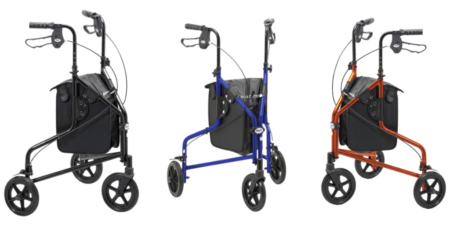
The three-wheeled rollator is lightweight and compact, making it easier to navigate around furniture and tight corners. It doesn’t have a seat, which keeps the weight down but removes the rest option. A three wheel rollator is best for people who are fairly mobile and just need gentle guidance and balance help.
Four-Wheel Rollator
The four-wheel rollator is the most common type and the one most people picture. It has a padded seat, hand brakes, a storage basket underneath, and a stable four-point base. A four-wheel rollator handles most indoor and outdoor surfaces well. It’s heavier than the three-wheel version but far more versatile.
Lightweight/Foldable Rollator
A lightweight rollator is built from aluminum or similar materials to reduce overall weight without sacrificing function. Most fold easily for car travel or storage. If you’re looking for a folding walker alternative that also has wheels, a lightweight foldable rollator is worth considering. Many weigh under 6 kg, which matters when you’re lifting it into a vehicle.
Rollator with Storage Basket
Most standard rollators include a basket, but some models prioritize storage more heavily — with larger bags, side pouches, or removable totes. A rollator with basket is especially handy for shopping trips or carrying daily essentials like a water bottle, phone, or medication. For seniors who want to stay independent on errands, this feature adds real practical value.
How to Choose Between a Walker and Rollator
Choosing the right mobility aid takes a bit of honest self-assessment. Here are the main factors to work through.
Assess Your Weight-Bearing Needs
If you need to put weight through your arms and the frame while walking — because your legs can’t fully support you — choose a walker. Rollators aren’t designed to bear body weight. Using a rollator like a weight-bearing device can cause it to roll forward unexpectedly.
Evaluate Your Balance and Strength
A walker is often better when balance is severely compromised. A rollator is ideal when your balance is moderately affected but your strength is reasonable. If you’d feel safer with something that can’t roll away, a walker if you need that stability is the right call.
Consider Your Living Environment (Indoors vs. Outdoors)
For indoor use on smooth floors, both work well, though a standard rollator may be bulky in small spaces. Outdoors, larger wheels on a four-wheel rollator handle cracked sidewalks and uneven ground much better than a basic walker. A rollator for outdoor use typically has bigger, pneumatic-style wheels for that reason.
Think About Daily Activities and Distance
Short trips around the house? A walker handles that easily. Longer outings — parks, malls, medical appointments — are more comfortable with a rollator, especially one with a seat. Think about how far you typically walk in a day when making this decision.
Check Hand Strength for Brakes
Rollators require hand strength to squeeze the hand brake. If arthritis or weakness makes gripping difficult, you may struggle to stop the rollator reliably. In that case, a walker may be the safer option, since it requires no braking at all.
Pros and Cons of Walkers
Pros of Walkers
- Provide firm, stable support — ideal for weight-bearing needs
- No wheels means no risk of rolling forward
- Lighter than most rollators
- Simple to use with no brakes or extra mechanics
- Often more affordable
- Easy to fold and transport
Cons of Walkers
- Lifting the frame repeatedly can fatigue the arms and shoulders
- No seat for resting mid-walk
- Limited storage options
- Less suited for longer distances or outdoor terrain
- The lifting motion can be difficult for people with upper body weakness
Pros and Cons of Rollators
Pros of Rollators
- Built-in seat for resting whenever needed
- Rolling motion reduces arm fatigue
- Storage basket keeps essentials close
- More comfortable for longer walks
- Larger wheels on four-wheel models handle outdoor terrain better
Cons of Rollators
- Not suitable for weight-bearing support
- Heavier and bulkier than most walkers
- Requires hand strength to operate the brake safely
- More expensive than basic walkers
- Wheels can be a hazard on slopes or icy surfaces
Safety Tips for Using Walkers and Rollators
Proper Fit and Height Adjustment
Your walker or rollator should be adjusted so your elbows bend at a slight angle — roughly 15 to 20 degrees — when your hands rest on the grips. Too high causes shoulder strain; too low makes you hunch. Most models adjust with push-button pins on the legs.
Brake Safety (for Rollators)
Always engage the brake before sitting down on a rollator seat. A rollator could roll forward if the brakes aren’t locked, causing a fall. Practice squeezing both hand brakes together until it becomes second nature before you rely on the seat in public.
Surface Considerations (Rugs, Snow, Ice)
Loose rugs are a trip hazard with any mobility device — secure them or remove them. In Canadian winters, both walkers and rollators become unpredictable on ice. Look for models with ice attachments or wheel covers, and avoid going out on untreated surfaces without assistance.
Avoiding Falls at Home
Keep pathways clear of clutter, cords, and obstacles. Don’t try to carry items in your hands while using either device — use a basket, bag, or apron attachment instead. Good lighting, especially at night, is one of the simplest ways to prevent falls.
Where to Buy Walkers and Rollators in Canada
You can find walkers and rollators at most Canadian pharmacies, medical supply stores, and home health retailers. Chains like Shoppers Drug Mart and London Drugs carry basic models, while specialty mobility equipment retailers offer a wider range including bariatric rollator options and best rollators for different terrain types.
Online retailers ship across Canada, and many offer detailed sizing guides. Some provinces have programs that subsidize mobility equipment costs for eligible individuals — checking with your provincial health authority is a good starting point. Occupational therapists can also help you get a proper fit before you buy, which reduces the chance of purchasing the wrong device entirely.
Frequently Asked Questions
What’s the difference between a walker and a rollator?
A walker is a stationary frame you lift and reposition with each step. A rollator is a wheeled walker you push continuously, with hand brakes to stop and usually a seat to rest on. The key differences come down to support level, mobility style, and what features you need day to day.
Which is better for seniors: a walker or rollator?
It depends on the individual. A walker is better for seniors who need significant support or are recovering from surgery. A rollator is better for seniors who can walk independently but want balance help and the option to rest. There’s no single best mobility aid for seniors — it comes down to specific needs.
Can I use a rollator outdoors in Canadian winter?
You can, but it takes caution. A rollator for outdoor use works best on clear, dry pavement. Ice, packed snow, and slush all reduce wheel traction significantly. Some people attach ice grippers or stabilizers during winter months. When conditions are poor, a walker with rubber-tipped legs may actually grip better than wheels.
Do walkers or rollators provide better support after hip or knee surgery?
A walker after hip surgery is the standard recommendation. Surgeons and physiotherapists prefer walkers early in recovery because you can bear weight through the frame. Rollators don’t offer that kind of support. Once mobility and strength improve, the transition to a rollator or cane may follow.
Are rollators safe for people with poor balance?
A rollator may not be the safest choice for severe balance problems because the wheels can move unexpectedly if not braked. Someone with significant balance issues is often better served by a standard walker. That said, a four-wheel rollator with locked brakes used as a walking frame can work — speak with a physiotherapist first.
How do I know the right size walker or rollator for me?
Stand upright with your arms at your sides. The grip height should align with your wrist. When holding the grips, your elbows should bend slightly. Most walkers for elderly users come in standard and tall versions, and adjustable leg height handles most body sizes. Always check the weight rating too, especially for heavier users.
Can caregivers help choose between a walker and rollator?
Absolutely. Caregivers often have the clearest picture of how someone moves around at home, how often they rest, and which surfaces they navigate daily. That real-world information is exactly what helps determine the best suited option. An occupational therapist can work with both the individual and the caregiver together.
Are walkers or rollators covered by Canadian health insurance?
Coverage varies by province and plan. Some provincial programs, like Ontario’s Assistive Devices Program, offer partial subsidies for mobility equipment. Extended health benefits through employers may also cover part of the cost. It’s worth calling your insurer directly and asking about mobility device coverage before purchasing.
Which is easier to fold and transport: a walker or rollator?
A folding walker generally folds flatter and lighter than a rollator, making it simpler to fit in a car trunk. A lightweight rollator folds too, but it’s typically heavier and wider when folded. If you travel frequently or use public transit, a basic folding walker may be easier to manage than most rollator models.
Can I add accessories like baskets to both walkers and rollators?
Yes. Many walkers accept clip-on baskets, bags, and tray attachments. Rollators typically already include a storage basket, but you can add extra pouches or a cup holder. Just make sure any attachment doesn’t shift your centre of gravity or obstruct your grip on the handles.